Thursday, January 14, 2010

ICA Boston

Saw some interesting work today at the ICA Boston. Noriko Furunishi combines and collages her landscape photos to create surrealistic expansive landscapes.
My approach is similar to this in that I am also using landscape photos and collage-like process to create new images. Unlike Furunishi, I paint the images after combining them.

This leads to the question my mentor has taught me to ask: what can paint add to the image?
Why not just enlarge these combined photos and simplify my process?

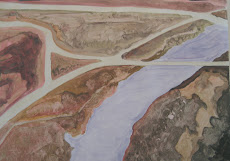
In the process of painting the image is transformed into something I have visualized. My interpretation of the idea becomes more evident as I work with the image and the concepts I am seeking to make visible. As I leave out the unnecessary and add in the parts that are missing, I make the painting more specific to my ideas, and less about the location in which the photographs were taken. The marks that I make with paint contain my thoughts in a liquid form. I can work with the extremes of light to dark and transparent to opaque. The application of paint can reveal not only the motion of the painter's hand, but also the attitude with which he or she has approached the painting. The intensity or carelessness of the artist's handling of the paint becomes another form of communication. It can also serve to emphasize the ideas behind the painting, which in my case, are the transformation of the land and the multiple viewpoints from which the landscape can be viewed. Can the new beauty of the urban landscape compete with the picturesque rural landscape? Maybe they are both present depending on your point of view.

Friday, December 4, 2009

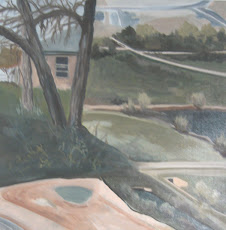
Last Homestead in process

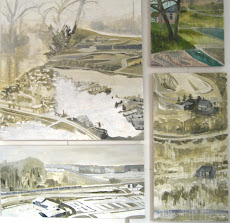
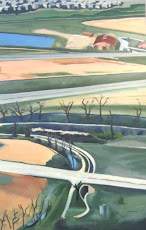
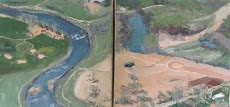
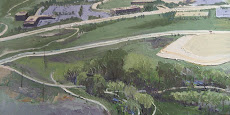
My recent paintings are part of a series called Last Homestead. The title refers the home that remains in the center of construction along the bike path. Each painting shows either the house itself or the area around it from both aerial and ground level views. I am exploring ways to show the inevitable change that is now a significant part of our American lifestyle. There is tension between the disappearance of the familiar and the emergence of newer and better opportunities.

Three of these paintings are still in the final stages of the underpainting in which I used a limited palette of black, white, yellow ochre, and burnt sienna. While experimenting with oil glazes on the 20x20 I learned that I need to tone down my transparent oil colors to get the effect that I am looking for. That painting has since been re-painted with the limited palette.

Sunday, November 1, 2009

Creation of the new vs Creation of the True

Found this short essay about Truth in Painting.

Friday, October 23, 2009

Painting in Process

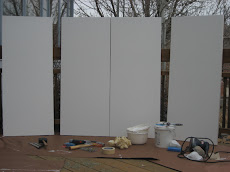
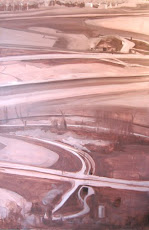
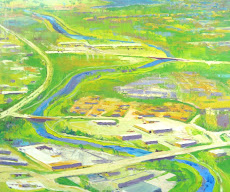
Encouraged to work larger, I am painting a 60 x 40" aerial view entitled Beyond the Bikepath.
I painted the monochromatic underpainting with acrylics. Now that I have blocked in the colors I think that the freshness of the underpainting is more successful than the colored version. I'm going to experiement with a limited palette and perhaps change the colors again once I have done these experiments.

Saturday, October 10, 2009

Disjunctive Space Workshop

I took a 2 day work shop with Melanie Authier this weekend. We discussed different types of space, and the effect of combining different or contrasting spaces in one painting. Our approach to the painting was through creating a collage with photographs and paper.


I asked Melanie about "contemporary landscape". She encouraged me to look at Dil Hildebrand whose paintings reflect his background in set design. She commented that contemporary landscape now often includes the influence of the urban environment.


Other artists she recommended are: Gary Evans, noting his process, which involves making sketches from his car and Monica Tap whose recent work involves the use of technology. Monica's series "One Second Hudson "depicts blurred images painted from a "quick time" video.

Friday, September 25, 2009

Multi panel paintings

I have been looking at multi panel paintings and have found that this format is popular with abstract artists who break one image into vertical bands, each segment painted on a separate panel.

The work of Trine Bumiller is also one continuous design, but her panels are different sizes, so the view of the image is determined by the arrangement of smaller canvases that together make one large composition. Her subject matter is often plants or trees. Don Eddy's work is in rectangles and squares, or alter-like pieces with a round edge at the top--sometimes arranged in vertical rows, and other times in pairs with a large vertical rectangle over a smaller vertical rectangle. His images are related by color or theme, but do not carry over into adjacent panels.

Bonnie Steinsnyder works in diptychs and triptychs as well as multi-paneled pieces, all of urban themes. Like Eddy, these each contain different but related images. Karen Kitchell often works in a series of 5 or more--often square panels all on the same horizontal plane. Her subject matter is plants or animal life that is not traditionally noticed or appreciated. Luis Gordillo's multi-paneled consists of vertical panels with related but not continuing design.

I plan to do a multi-panel piece that is related but not a continuing design. I am thinking about doing a triptych, but would like to keep the format flexible so that the panels could be hung in a row as one large rectangle, or in a balanced but non-symmetrical order.

Friday, September 11, 2009

Contemporary Painter

In looking at contemporary landscape painters, Sandy Litchfield exemplifies an artist who seems to enjoy nature as subject, but has developed a contemporary format for her work. Litchfield works on canvas, paper, and on the walls of galleries! Her work is very organic and includes painted collage-like areas of color and parts of images. The gallery website from her 2006 show describes her work as "map-like abstract paintings". I have thought of combining aerial and ground views, so I enjoy looking at how Sandy Litchfield solves this design problem. In describing her as contemporary, this article includes the following qualities: precise editing, a crisp approach to surface, broad array of technique, fresh, and suggestive.