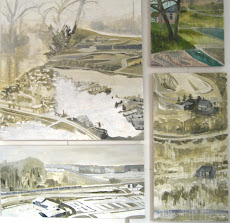
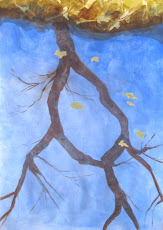
I took a 2 day work shop with Melanie Authier this weekend. We discussed different types of space, and the effect of combining different or contrasting spaces in one painting. Our approach to the painting was through creating a collage with photographs and paper.
I asked Melanie about "contemporary landscape". She encouraged me to look at Dil Hildebrand whose paintings reflect his background in set design. She commented that contemporary landscape now often includes the influence of the urban environment.
Other artists she recommended are: Gary Evans, noting his process, which involves making sketches from his car and Monica Tap whose recent work involves the use of technology. Monica's series "One Second Hudson "depicts blurred images painted from a "quick time" video.
Saturday, October 10, 2009

Friday, September 25, 2009
Multi panel paintings
I have been looking at multi panel paintings and have found that this format is popular with abstract artists who break one image into vertical bands, each segment painted on a separate panel.
The work of Trine Bumiller is also one continuous design, but her panels are different sizes, so the view of the image is determined by the arrangement of smaller canvases that together make one large composition. Her subject matter is often plants or trees. Don Eddy's work is in rectangles and squares, or alter-like pieces with a round edge at the top--sometimes arranged in vertical rows, and other times in pairs with a large vertical rectangle over a smaller vertical rectangle. His images are related by color or theme, but do not carry over into adjacent panels.
Bonnie Steinsnyder works in diptychs and triptychs as well as multi-paneled pieces, all of urban themes. Like Eddy, these each contain different but related images. Karen Kitchell often works in a series of 5 or more--often square panels all on the same horizontal plane. Her subject matter is plants or animal life that is not traditionally noticed or appreciated. Luis Gordillo's multi-paneled consists of vertical panels with related but not continuing design.
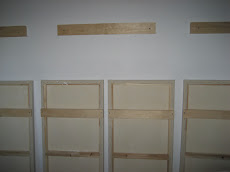
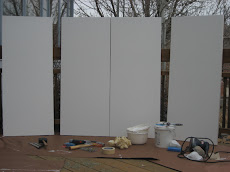
I plan to do a multi-panel piece that is related but not a continuing design. I am thinking about doing a triptych, but would like to keep the format flexible so that the panels could be hung in a row as one large rectangle, or in a balanced but non-symmetrical order.
The work of Trine Bumiller is also one continuous design, but her panels are different sizes, so the view of the image is determined by the arrangement of smaller canvases that together make one large composition. Her subject matter is often plants or trees. Don Eddy's work is in rectangles and squares, or alter-like pieces with a round edge at the top--sometimes arranged in vertical rows, and other times in pairs with a large vertical rectangle over a smaller vertical rectangle. His images are related by color or theme, but do not carry over into adjacent panels.
Bonnie Steinsnyder works in diptychs and triptychs as well as multi-paneled pieces, all of urban themes. Like Eddy, these each contain different but related images. Karen Kitchell often works in a series of 5 or more--often square panels all on the same horizontal plane. Her subject matter is plants or animal life that is not traditionally noticed or appreciated. Luis Gordillo's multi-paneled consists of vertical panels with related but not continuing design.
I plan to do a multi-panel piece that is related but not a continuing design. I am thinking about doing a triptych, but would like to keep the format flexible so that the panels could be hung in a row as one large rectangle, or in a balanced but non-symmetrical order.
Friday, September 11, 2009
Contemporary Painter
In looking at contemporary landscape painters, Sandy Litchfield exemplifies an artist who seems to enjoy nature as subject, but has developed a contemporary format for her work. Litchfield works on canvas, paper, and on the walls of galleries! Her work is very organic and includes painted collage-like areas of color and parts of images. The gallery website from her 2006 show describes her work as "map-like abstract paintings". I have thought of combining aerial and ground views, so I enjoy looking at how Sandy Litchfield solves this design problem. In describing her as contemporary, this article includes the following qualities: precise editing, a crisp approach to surface, broad array of technique, fresh, and suggestive.
Monday, August 31, 2009
Aerial Landscapes
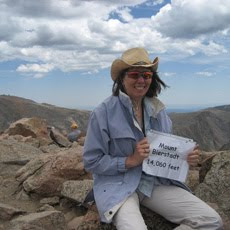
My ideas about nature have been strongly influenced by spending time in the Rocky Mountains of Colorado. Hiking, horseback riding, and sking in the vastness of open land with no visible manmade structures surrounded by 14,000 foot mountains has given me an appreciation for the beauty and power of the natural world. It is common to see deer and other wildlife in these places.
Near my home, the urban environment offers designated open space to preserve trees and small animal life. There are concrete bike paths to access the river, and many people walk, jog, rollerblade, and cycle along these paths. I accept urban parks as a convenient substitute for the more authentic experiences of nature in the "high country" especially since I can still see the tall mountain peaks in the distance.
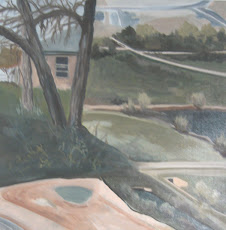
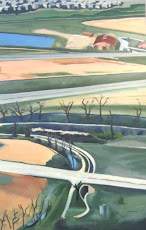
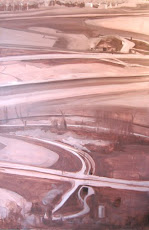
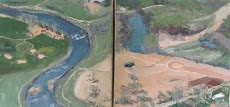
Reynolds Landing I and II reveals the attempts that have been made to make "nature" available to everyone by creating a park along the riverbank. On the other side of the river is a golf course--another man-made park. These areas allow us to feel that we are in nature, yet the concrete paths and proximity to major streets are indicators of a controlled urban environment.
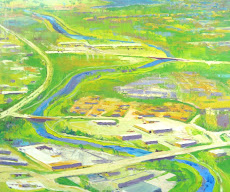
Viewing these places from the air has increased my awareness of the artificiality of these environments. In Platte River Pathways I have intensified and enhanced the colors to emphasize the unnatural attempts to immitate nature in small areas sandwiched between the streets and the river. At the same time, there is evidence of the river's influence on the urban environment in that the paths, streets, and structures have been built around it.
Near my home, the urban environment offers designated open space to preserve trees and small animal life. There are concrete bike paths to access the river, and many people walk, jog, rollerblade, and cycle along these paths. I accept urban parks as a convenient substitute for the more authentic experiences of nature in the "high country" especially since I can still see the tall mountain peaks in the distance.
Reynolds Landing I and II reveals the attempts that have been made to make "nature" available to everyone by creating a park along the riverbank. On the other side of the river is a golf course--another man-made park. These areas allow us to feel that we are in nature, yet the concrete paths and proximity to major streets are indicators of a controlled urban environment.
Viewing these places from the air has increased my awareness of the artificiality of these environments. In Platte River Pathways I have intensified and enhanced the colors to emphasize the unnatural attempts to immitate nature in small areas sandwiched between the streets and the river. At the same time, there is evidence of the river's influence on the urban environment in that the paths, streets, and structures have been built around it.
Wednesday, July 1, 2009
What is a Contemporary Art Museum?
Looking at the purpose of contemporary art museums seems to help further define the word contemporary. These museums seem to imply that their definition of contemporary is the recent past--this past year vs the past 3 decades. This is a description of the Contemporary Art Museum of Houston:
"The Contemporary Arts Museum Houston is an idea and a place shaped by the present moment. The Museum exemplifies the dynamic relationship between contemporary art and contemporary society through its exhibitions, public and educational programs, and publications. The CAMH provides the physical and intellectual framework essential to the presentation, interpretation, and advancement of contemporary art; it is a vibrant forum for artists and all audiences, and for critical, scholarly, and public discourse.
The Contemporary Art Museum of St. Louis has a similar goal:
"As St. Louis’s forum for interpreting culture through contemporary visual art, we connect our visitors to the dynamic art and ideas of our times. As a gathering place for experiencing contemporary art and culture, we push the boundaries of innovation, creativity and expression."
"The Contemporary Arts Museum Houston is an idea and a place shaped by the present moment. The Museum exemplifies the dynamic relationship between contemporary art and contemporary society through its exhibitions, public and educational programs, and publications. The CAMH provides the physical and intellectual framework essential to the presentation, interpretation, and advancement of contemporary art; it is a vibrant forum for artists and all audiences, and for critical, scholarly, and public discourse.
The Contemporary Art Museum of St. Louis has a similar goal:
"As St. Louis’s forum for interpreting culture through contemporary visual art, we connect our visitors to the dynamic art and ideas of our times. As a gathering place for experiencing contemporary art and culture, we push the boundaries of innovation, creativity and expression."
What is Contemporary Art?
Contemporary art has been defined as "the art of our time". But who are WE and what is OUR TIME? One writer from About.com describes it as art since 1970. This description also includes the observation that contemporary art seems to be more "socially concious"and connected to issues such as feminism, globalization, or multiculturalism than art of previous generations.
What IS "Contemporary" landscape painting?
I've been looking at landscape shows hosted by art galleries within the past 5 years. Although many people like to use the word "contemporary" to describe their work, I have seen that there are varied opinions about what defines the contemporary landscape. Last fall, the Christinerose Gallery in Chelsea hosted a show entitled, From Above and Beyond: New Perspectives in Contemporary Landscape.
Subscribe to:
Posts (Atom)